Showing posts with label Conservation. Show all posts

Wednesday, September 30, 2009

More about "Big Bad"


This confirms what my Adirondack neighbors have been relating to me for the past few years, that the ADK coyotes are bigger and badder than they once were... Not to mention the fact that they are becoming bolder and more brazen by the day, taking unsuspecting hapless housecats, and succulent small dogs at will from their yards.
There's a pretty interesting write-up here at the Adirondack Almanac, that explains the evolution of the coy-wolf.

It's certainly food for thought, and I suppose should put to rest the controversy on whether wolves should be reintroduced to the Adirondacks where they once reigned. Of course, for those that love conspiracy theories, wolves could have been reintroduced surrepticiously, and what we're now seeing is the fruits of that labor..

I do know that I saw a canine out on the Blue Ridge Road beyond the road to Tahawus that looked stunningly wolf-like... Little on this earth that can send a chill up one's spine like that..

Am I happy or upset about this new development??

I guess I just can't answer that yet... But I'm will to give it a chance... very cautiously!

Read more about the coy-wolf hybrid here..

Tuesday, January 6, 2009

A favored Winter Passtime


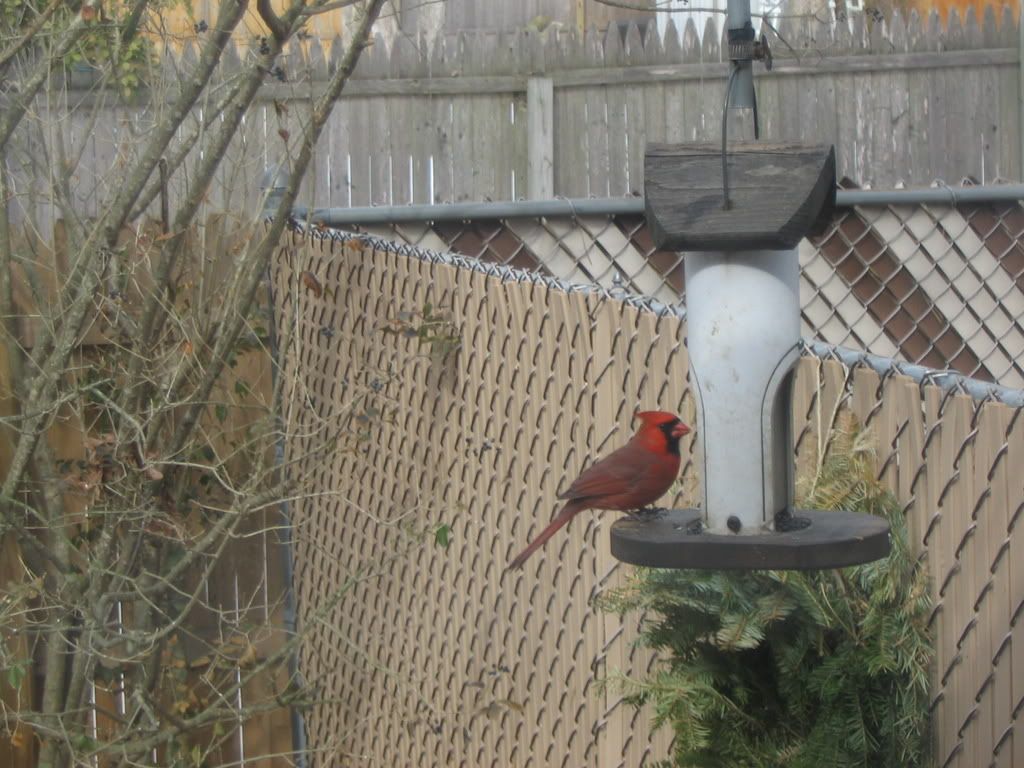
Watching the birds at the feeders..

They're antics never fail to make me laugh out loud, and they've all got different personalities!
The Cardinals, as shown seem very dominant, and don't care for other birds in the vicinity while they're feeding..
The Tufted Titmouse, a placid little bird... Very gentlemanly
Goldfinch.. a real little beauty!
The Chickadee, a real pleasure to have around. Beautiful little birds and very mellow..I always enjoy looking out to see a Chickadee..
This year, we've had very many Juncos.. They make a helluva mess. They kick ten seeds off with their feet for every seed they eat. But, they leave alot on the ground for the Doves and Sparrows.
The ever present Blue Jays, with their raucous vocalizations and rambunctious attitudes.. Pretty much the dominant bird down here.
The Red Headed Woodpecker.. A beautiful bird that does not come on a regular basis, but is always a treat to watch..
There's also a bird that is new this year and I've yet to identify. It looks like a small finch, with a light greed body and wings that resemble a sparrow.. I've got to dig out the guide.

And then... The dreaded squirrels, who's numbers this year are great. I won't do them any harm for eating the expensive Sunflower Seeds, but they can sure tick me off.. Hell, the squirrels don't have the reasoning power to figure out that I put the seeds out for the birds and not for them, and the way I look at it, they're just tryin' to get through another day with as little strain and pain, just like me!
But this year there is a new twist.. I hung a "Cobs-a-twirl" from the birch tree.. It holds four corn cobs, and is free to turn as the squirrels jump for a cob. I haven't had it up long enough yet to provide any antics, but from accounts at the feed store, the little rodents can provide endless entertainment with it...

Time will tell, but in the meantime, I enjoy all the wildlife that show up for a free meal "on me"..

Friday, October 24, 2008

A thought for the day...


From an unknown Native American tribe...


Treat the earth well: it was not given to you by your parents, it was loaned to you by your children. We do not inherit the Earth from our Ancestors, we borrow it from our Children. - Tribe Unknown


We can learn much from this country's first inhabitants, and the more litter I see on our roads, the more smog I see in our air, and the more plastic homes where there once existed woods or forest make me believe this all the more...

Thursday, May 1, 2008

A Storm Cloud Gathering?

A recent NYS Department of Environmental Conservation press release states..

DEC has announced a new initiative to switch to "green ammo" from lead based ammunition for firearms training to help reduce the impact from lead at firing ranges.
The ammunition DEC will be using is considered "green" because it is lead free and includes non-toxic primers. This combination greatly reduces the impact of firearms training on the environment. Lead poisoning is a serious human health risk and excessive exposure to lead, primarily from ingestion, can cause increased mortality rates in cattle, sheep and waterfowl.
DEC is currently phasing in the new ammunition with the agency's 330 environmental conservation officers and 134 forest rangers. The DEC expends over 150,000 rounds of ammunition annually, including during regional in-service training exercises, as well as at the Department's 26 week residential basic training academy.

For more information about lead in bullets, go to EPA's website at:

www.epa.gov


-------------------------------------------------------------------------------------


We've got a new DEC Commissioner in NY, Pete Grannis, appointed by our illustrious former governor, the legendary Eliot Spitzer, over the objections of Sportsmen, Environmental groups, and almost everyone else who had an interest.
Does Mr. Grannis expect DEC officers, the most powerful Peace Officer in the State, BTW, to train with one type of ammo and expect to enforce laws against possible violent offenders with another??
Pete Grannis is a political hack fresh from NYC politics. His appointment gave former Governor Spitzer another chance to flex his muscles (no, not that one) and thumb his nose at the people of the State of New York...
In any case, with Commissioner Grannis at the helm, I fully expect much more stupidity to follow..
I know this.. I'm laying in lead in 6's, 7 1/2's, and 8's even if the price is high... We're in a whole new environment with folks like Pete Grannis at the helm.

Friday, April 25, 2008

The Story of a Conservationist


Paul Schaefer, pictured left in 1963, was a hunter, hiker, and conservationist of uncommon virtue since he was 11 years old in 1919, wearing a tiny pin stamped with "New York Conservationist" after attending a meeting held by State Conservation officials.
Until his death in 1997 at his beloved home in Niskayuna, NY, at the age of 87, Schaefer had preserved that memento in a small leather change purse.
This great monument of a man went to work after completing just one year of high school, to help support his family, yet he became the most vocal and articulate supporter for preservation of the Adirondacks. Schaefer's greatest fight for preservation came during the late 1940's, when Utility companies proposed 35 major hydroelectric dams and reservoirs that would have involved clearcutting and flooding several hundred thousand acres in the Adirondack Park... including the largest deer wintering grounds on the Moose River Plains.
In his forward to Schaefer's book, Defending the Wilderness, Charles Callison writes "As the decades passed, others may have been up front in the halls of legislation or courts of law, but it was Paul Schaefer who was their coach, their cheerleader, their pamphleteer and their supplier of facts, facts gleaned not only from books, but firsthand on innumerable hikes and camping trips into remote reaches of the great region, as often carrying a camera as a fishing rod or deer rifle."
Schaefer's legacy is now preserved at the Association for the Protection of the Adirondacks, temporarily based ay his home in Niskayuna, pictured above right..
Paul Schaefer's efforts are still felt today, from his rustic cabin in Baker's Mills, to the entire area inside the Blue Line...
Every Adirondacker owes Paul Schaefer a debt of gratitude...

Thursday, March 27, 2008

New York's Bats in trouble

This is a little off topic, but, IMO of great importance. I appreciate bats flying the area at night eating insects, and, they're a species that needs our help and protection...
This, from the NYS DEC website..

Bat Die-off Prompts Investigation
Thousands of hibernating bats are dying in caves in New York State and Vermont from unknown causes, prompting an investigation by the New York State Department of Environmental Conservation (DEC), as well as wildlife agencies and researchers around the nation. The most obvious symptom involved in the die-off is a white fungus encircling the noses of some, but not all, of the bats. Called "white-nose syndrome," the fungus is believed to be associated with the problem, but it may not necessarily contribute to the actual cause of death. It appears that the affected bats deplete their fat reserves months before they would normally emerge from hibernation and die as a result.


Stay Away

Disease spreads easily within hibernaculums, housing thousands of bats in a small areaUntil researchers understand the cause and how it is spread, state environmental officials and caving organizations are asking people not to enter caves or mines with bats until further notice to avoid possible transfer of the disease from cave to cave. Vermont officials are making a similar request.

"What we've seen so far is unprecedented,'' said Alan Hicks, DEC's bat specialist. "Most bat researchers would agree that this is the gravest threat to bats they have ever seen. We have bat researchers, laboratories and caving groups across the country working to understand the cause of the problem and ways to contain it. Until we know more, we are asking people to stay away from known bat caves." Bat biologists across the country are evaluating strategies to monitor the presence of the disease and collect specimens for laboratory analysis. Biologists are taking precautions-using sanitary clothing and respirators when entering caves-to avoid spreading the disease.

No Safety in Numbers
Bat populations are particularly vulnerable during hibernation as they congregate in large numbers in caves-clusters of 300 per square foot in some locations-making them susceptible to disturbance or disease. The vast majority of the hundreds of thousands of bats known to hibernate in New York do so in just five caves and mines. Because bats often migrate hundreds of miles to their summer range, effects on hibernating bats can have significant implications for bats throughout the Northeast.

Indiana bats, a state and federally endangered species, are perhaps the most vulnerable. Half the estimated 52,000 Indiana bats that hibernate in the state are located in just one former mine-a mine that is now infected with white-nose syndrome. Eastern pipistrelle, northern long-eared and little brown bats also are dying. Little brown bats, the most common hibernating species in the state, have sustained the largest number of deaths.

Searching for Answers
DEC has been working closely with the Vermont Fish and Wildlife Department, the U.S. Fish and Wildlife Service, the Northeast Cave Conservancy and the National Speleological Society, along with other researchers from universities and other government agencies. DEC will provide updates as they become available.

http://www.dec.ny.gov/environmentdec/41767.html


A little of my own thoughts on bats..

Bats are mammals. They are warm blooded, have fur, give birth to babies, and nurse their babies with milk. Only the Mother cares for the young.
Although often described as "flying mice", bats are not rodents and are more closely related to primates and humans. Bat wings are similar to a human hand, having a thumb and four fingers, as a support for the thin, leathery membrane that forms their wings.
Bats are also long lived. The oldest ever documented was found in a NY mine, where it had been banded 34 years earlier.
I plan on building some bat boxes for the area surrounding my Adirondack camp.

For information on building bat boxes, visit Bat Conservation International's website...

http://www.batcon.org/home/default.asp