For those with big runners that run the Garmin Astro GPS system, there are software updates available.
I called with a question because one of the blue charging LED's is burnt out. One still is operative, and I can tell when the unit is on charge, so I'll just leave it for now. The tech offered to walk me through the software updates to both the 220 gps unit and the dc-30 collar. I was way behind the times, and numerous updates had been available before the most current ones.
In any case, both units are now current with the latest updates, and the latest info for the chipset..
I'm expecting even better performance from an already fabulously performing tool!
Showing posts with label Training. Show all posts
Showing posts with label Training. Show all posts
Tuesday, May 19, 2009


Monday, February 23, 2009
Something new under the sun..

The vibration paging feature has been around on some brands of e-collars for some time, but never before as the primary method of stimulation, and not adjustable for intensity.
Unleashed Technology has brought us something new, in that the primary method of stimulation, and attention getting, is vibration, and the secondary means on the more advanced collars, is electrical stimulation. The vibratory paging feature is adjustable for intensity.. This is very much the opposite of what dogtra users have been using for years, and is a new departure in dog training using positive reinforcement.
I find this new direction somewhat interesting, and may in the future be experimenting with it. It certainly opens new avenues for training, and giving long range commands, to dogs who have lost hearing, as many gundogs ultimately do. That advantage alone is eminently worthwhile.. Be sure to click on "Product Training" on the Unleashed Technology site to get an idea of what the system is all about, and how it differs from traditional e-training.
As an aside, I've been a Tri-Tronics user since I cut my teeth, and once one gets used to the tube style transmitter with three levels of stim at your fingertips, it's hard to move to another style. Further, TT does not offer vibration, only a tone, which I have found useful.. But, vibration offers many advantages that we never thought of before..
We'll all have to decide whether this new departure will fit into our bag of tricks or not, but it's always nice to add a new option that could possibly help that dog that hates juice, or has been turned off by it in the past.. It never hurts to have something just a little bit different to try in some cases.
Maybe it's time for an old dog like myself to learn some new tricks...
More in the future
Wednesday, December 3, 2008
Information and Disinformation on e-collars

I've come almost full circle on e-collar usage..
E-collars, in the old days, were punishing tools. Their most effective usage was for "trashbreaking", or running unwanted game, and for that job they were very effective, because that is the area where high levels of stimulation are necessary. And that is where the first generations of e-collars delivered. The originals were non-adjustable.. just prodigious doses of electric delivered to the dog's neck..
Later, collars were available with interchangeable "chips" that could vary the stimulation sent to the collar. Still imperfect, as the handler could still only work within the range of the chip inserted in the collar.
Modern e-collars overcome all the shortcomings of the early designs by providing a means of altering the range of stimulation at the transmitter.
This makes the e-collar a highly effectivev tool for enforcing known commands.
I started with checkcords... also an imperfect too because of all the violent jerking involved. An improperly used checkcord can turn a dog off to trainiong almost to the degree that an improperly used e-collar can!
Once the e-collars improved, I moved to the electronics for more than just running off game.. I was happy for a time, but I still found the e-collar to be an imperfect tool, at least to my mind, for working around birds.. An unintended stimulation, or a mistake in applying it, can cause setbacks..
So, I'm back to the checkcord for foundation work, and apply the e-collar for finishing touches.. Low levels of stimulation are all that is needed here.. And I wopuld not apply anything to my dogs without testing it out first on myself..
The lowest levels are not even perceptible to me, so I have no qualms about applying it for corrections to the dog..
Obviously, not everyone feels the way I do, and there is much disinformation and misunderstanding concerning e-collars and their proper use.. To raise sentiment, most literature that takes issue with their use still refer to the tools as "shock collars".. This is usually a tipoff that the imformation is decidedly biased..
This is an example of an article that is totally wrong in it's information and it's intent.
Give it a read and post comments as you give it some thought..
For an appropriate use of an e-collar... look here...
Monday, November 10, 2008
Gundogs on a budget
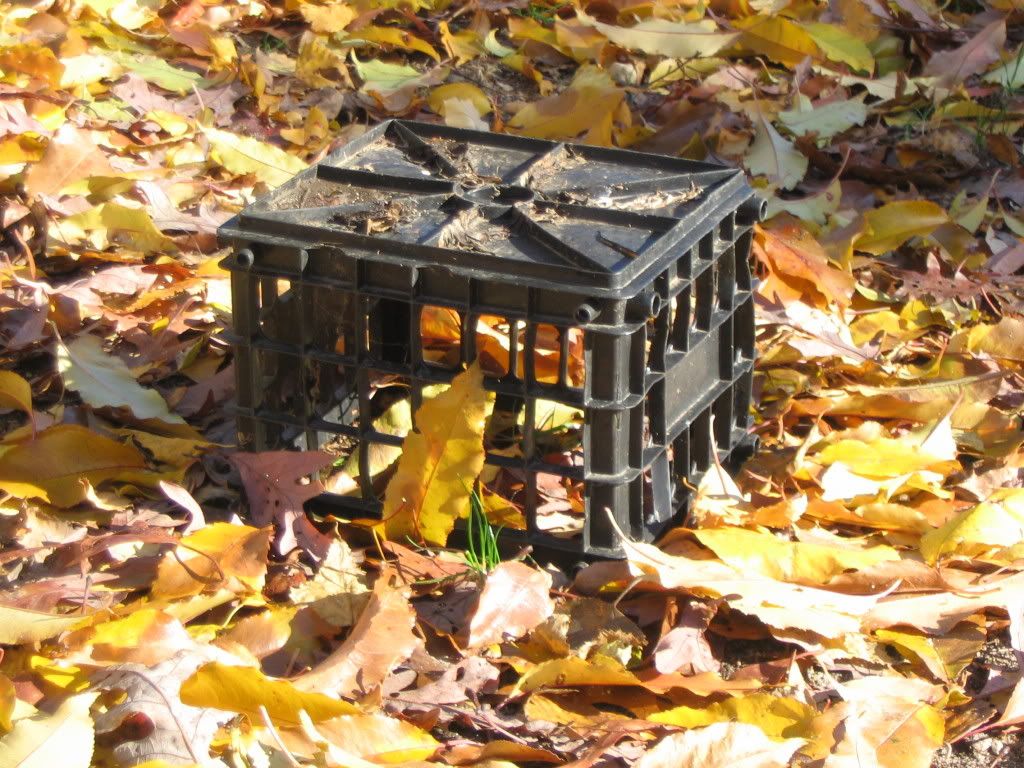 Or even if you're not on a budget...
These small bins, this one measures about 8 1/2 x 7 1/2 x 6 inches deep, are available at Wal-Mart, Staples, or any number of places including small stationary stores.
They make a great training aid for holding training birds such as pigeons or quail, for those that do not want to invest in, or do not believe in using electronically controlled spring traps with their dogs.. We call these small bins "Tracy Traps" in reference, and deferance, to the Master trainer George Tracy, of Summerhill Kennels in PA., where these traps were first seen in use.
The box pictured has seen it's share of use and is due for replacement, but all that needs to be added is a string (not necessary) and a brick or rock to hold the box doen over the pigeon (necessary).
These Tracy Traps are also great for planting birds in multiples. Many young dogs think that once one bird is gone, that it's time to move on. The use of another bird in one of these boxes alongside an e-trap, staunches the dog up and make training steady to wing easier, because the dog is forced to assume that another bird could be present. The benefits of this approach can be seen with most dogs virtually immediately... But, one of the greatest attributes is the excellent airflow around the bird, providing a powerful and natural scent cone.
Another benefit is the facts that most trainers believe that a dog cannot be finished without birds coming off the ground. These cheap boxes serve that purpose admirably, as would the more expensive Higgins traps. Further, the trap can be kicked over, as in kicking around under the dog's point as in flushing a bird, or tipped slowly, allowing the pigeon to walk out under the dog's nose, providing a real tease!
For the investment, these boxes are certainly worth every penny, and might just help with that dog that needs that last little bit of polish...
Saturday, November 1, 2008
A funny little story about launchers
This story, taken from the Foster Award site relates a funny story on early bird launchers and there usage. This is the story as related to Ryan Frame...
The Bird Launcher
by Travis Gellhaus (as told to Ryan Frame)
I grew up around bird dogs. Pointers specifically. My father was a dog trainer and a carpenter too I suppose. His successful veterinary practice, however, meant that dog training and carpentry were, to my father, hobbies rather than professions, and without getting into more detail than is necessary, that was probably a good thing.
At some point, Dad decided that we needed a bird launcher to help us train the dogs and, even though he could have easily paid to have one delivered, no thought entered his head other than to build it himself. He had no directions or even photos to work from - that would not have been any fun., I suppose. As a base for the launcher, he chose a choice piece of maple that was lying around waiting for its purpose in life.
Unfortunately, the block of maple was about two inches thick, weighed some sixty pounds, and probably, had he sold this nice cut of maple, he would have made enough money to pay for a bird launcher. But again, that would not have been any fun.
Anyway, setting this hunk of maple on the garage floor, he bolted down a homemade cage to it, hooked up a piece of canvas to springs, devised a tripping mechanism, and rigged up a servo engine that he had laying around somewhere. Soon this rather unsightly device had taken shape and was ready for testing. We lugged it outside into the yard and rigged it up with a pigeon encircled in the canvas. The cage, however, was open at the ends and the pigeon merely crawled out the opening and flew off. So it was back into the garage for more ‘adjustments.’
With that little design flaw corrected, we decided to do further preliminary testing right there in the garage. We convinced ourselves that it was wise to test indoors before moving to the field (neither of us was quite ready yet to admit that this device was a bit cumbersome to lug back and forth). Dad put a plastic bottle inside the canvas, and, folding it in, set the mechanism. While he was still hovering over it however, it sprung unexpectedly and threw that bottle right into his face with such force that it caused a bloody nose and put a small cut above his eye. Naturally, this just made Dad more determined. I can still him working through the blood and bruises to make the final adjustments to the release mechanism. Then it was ready for testing again. Dad stuck the bottle in the canvas (making sure that his head was well out of the way) and hooked up the latch.
We stood back and he pushed the remote button. VAWOOOM! It shot the bottle up immediately. Success! Or …. Uh… success for the most part. The bottle, even though it was just plastic, had caused some light injuries to my Dad on the first test. Then the second test had resulted in a pretty good sized dent in the garage ceiling. Perhaps we should have taken these observations as a hint that more adjustments were needed. We didn’t.
Any way it was time to take it to the field for a real life test. I lugged the thing out into the yard, we rigged up a pigeon inside, and we check corded a dog into its vicinity. The dog pointed the bird, took a small step and Dad hit the button. VAWOOOM! The bird went up like a rocket, unable to even spread its wings until it was more than fifty feet in the air. That pigeon went up so fast that the dog never even saw it go by, never looked up, and never saw the bird fly off. Nevertheless, we had our bird launcher… with due emphasis on "launcher." Sure it required some muscle and effort to move it around. And sure… it scared the crap out of some of the dogs when it went off. And, sure, you could not put it near a tree or you would just splatter the pigeon on a branch. And even though, in short order, it just sat in the garage gathering cob webs and dust, we still were proud of it.
Together (mostly him) we managed to finish two pointer field champions. We also gathered up a lot of memories along the way but none stands out more than the ordeal of the building of that homemade bird launcher.
(Note: Travis Gellhaus is a pro trainer and chief proprietor of Hawkeye Creek Kennels Of Thunder Bay, Ontario.)
The Bird Launcher
by Travis Gellhaus (as told to Ryan Frame)
I grew up around bird dogs. Pointers specifically. My father was a dog trainer and a carpenter too I suppose. His successful veterinary practice, however, meant that dog training and carpentry were, to my father, hobbies rather than professions, and without getting into more detail than is necessary, that was probably a good thing.
At some point, Dad decided that we needed a bird launcher to help us train the dogs and, even though he could have easily paid to have one delivered, no thought entered his head other than to build it himself. He had no directions or even photos to work from - that would not have been any fun., I suppose. As a base for the launcher, he chose a choice piece of maple that was lying around waiting for its purpose in life.
Unfortunately, the block of maple was about two inches thick, weighed some sixty pounds, and probably, had he sold this nice cut of maple, he would have made enough money to pay for a bird launcher. But again, that would not have been any fun.
Anyway, setting this hunk of maple on the garage floor, he bolted down a homemade cage to it, hooked up a piece of canvas to springs, devised a tripping mechanism, and rigged up a servo engine that he had laying around somewhere. Soon this rather unsightly device had taken shape and was ready for testing. We lugged it outside into the yard and rigged it up with a pigeon encircled in the canvas. The cage, however, was open at the ends and the pigeon merely crawled out the opening and flew off. So it was back into the garage for more ‘adjustments.’
With that little design flaw corrected, we decided to do further preliminary testing right there in the garage. We convinced ourselves that it was wise to test indoors before moving to the field (neither of us was quite ready yet to admit that this device was a bit cumbersome to lug back and forth). Dad put a plastic bottle inside the canvas, and, folding it in, set the mechanism. While he was still hovering over it however, it sprung unexpectedly and threw that bottle right into his face with such force that it caused a bloody nose and put a small cut above his eye. Naturally, this just made Dad more determined. I can still him working through the blood and bruises to make the final adjustments to the release mechanism. Then it was ready for testing again. Dad stuck the bottle in the canvas (making sure that his head was well out of the way) and hooked up the latch.
We stood back and he pushed the remote button. VAWOOOM! It shot the bottle up immediately. Success! Or …. Uh… success for the most part. The bottle, even though it was just plastic, had caused some light injuries to my Dad on the first test. Then the second test had resulted in a pretty good sized dent in the garage ceiling. Perhaps we should have taken these observations as a hint that more adjustments were needed. We didn’t.
Any way it was time to take it to the field for a real life test. I lugged the thing out into the yard, we rigged up a pigeon inside, and we check corded a dog into its vicinity. The dog pointed the bird, took a small step and Dad hit the button. VAWOOOM! The bird went up like a rocket, unable to even spread its wings until it was more than fifty feet in the air. That pigeon went up so fast that the dog never even saw it go by, never looked up, and never saw the bird fly off. Nevertheless, we had our bird launcher… with due emphasis on "launcher." Sure it required some muscle and effort to move it around. And sure… it scared the crap out of some of the dogs when it went off. And, sure, you could not put it near a tree or you would just splatter the pigeon on a branch. And even though, in short order, it just sat in the garage gathering cob webs and dust, we still were proud of it.
Together (mostly him) we managed to finish two pointer field champions. We also gathered up a lot of memories along the way but none stands out more than the ordeal of the building of that homemade bird launcher.
(Note: Travis Gellhaus is a pro trainer and chief proprietor of Hawkeye Creek Kennels Of Thunder Bay, Ontario.)
Tuesday, April 1, 2008
Bad news for the lowly pigeon
NEW YORK - Put your hands up and back away from the breadcrumbs. Feeding New York City pigeons could soon be banned under a proposal to thin the flocks of the birds sometimes referred to as "rats with wings."
City Councilman Simcha Felder plans to introduce legislation to ban pigeon feeding and fine those caught flouting the ban $1,000.
The ammonia and uric acids in pigeon droppings can rust steel and corrode infrastructure, he wrote in a report outlining potential solutions to the pigeon problem. A pigeon excretes an average 25 pounds of droppings per year, he said.
"We have pigeons doing whatever they do all over the city without anyone trying to stop it," Felder said outside City Hall on Monday. "If people like pigeons, take them into their homes, feed pigeons in your house and let them crap all over the place in your living rooms."
He also suggested appointing a "pigeon czar" to orchestrate the fight, a plan that has ruffled the feathers of animal lovers.
"Cities are lifeless places. People don't appreciate the fact that we have some wildlife," said Al Streit, director of The Pigeon People, an organization that rescues injured birds.
Felder countered that "the fact is that people have been disgusted and annoyed." Noting that he frequently dodges pigeon droppings at his Brooklyn subway station, Felder added: "I might as well say that I'm sick and tired of it."
What other cities have done
In his report, Felder recommends looking at how other cities have gone about reducing their pigeon populations.
London Mayor Ken Livingstone banned pigeon feeding in Trafalgar Square, closed down the official feed vendors there and brought in hawks to scare away pigeons that remained.
Los Angeles has begun a trial use of pigeon birth control called OvoControl P.
Venice, Italy, is trying to stop the sale of bird seed in St. Mark's Square and prevent pigeons from chipping away at marble statues and buildings. Licensed bird feed sellers do not want to go and animal rights activists have also expressed concern.
And Basel, Switzerland, helped reduce its pigeon population by stealing the birds' eggs and replacing them with fakes, fooling them.
New York Mayor Michael Bloomberg has not endorsed a feeding ban but said at a news conference Monday that he thought the city's pigeons were a problem.
"We do have a lot of pigeons and they do tend to foul a lot of our areas, and people would be better off not feeding the pigeons," he said.
Attack on Chihuahua ended hawk strategy
Attempts to shoo pigeons from parts of the city have had mixed results.
Electrifying roosting areas under elevated subway tracks has had some success, but noise deterrents — using recordings of hawks and other predators — haven't worked as well because New York City pigeons appear to be unfazed by noise.
An attempt to use hawks in Manhattan's Bryant Park in 2003 was scrapped after a hawk attacked a pet Chihuahua.
European settlers brought pigeons to North America as domesticated birds; the animals that rule New York City are their wild descendants.
Despite their reputation as disease carriers, the city Health Department does not consider pigeons a major danger and says the average New Yorker is not at risk of catching anything from the birds or their droppings.
Hearings on Felder's plan may be called before the end of the year.
BlacknTan's take..
Without the pigeon, the birddog trainer would be in dire straits... The pigeon is no more a "flying rat" that the bat is a "flying mouse"! Just ask any of the legions of pigeon fanciers!
For the bird dog owners who's pups will point them, and some dogs disrespect pigeons to the point of refusing to point them, the birds provide cheap, consistent, and re-usable training.
Pigeons go with birddogs and horses the way bread goes with butter and jam!
City Councilman Simcha Felder plans to introduce legislation to ban pigeon feeding and fine those caught flouting the ban $1,000.
The ammonia and uric acids in pigeon droppings can rust steel and corrode infrastructure, he wrote in a report outlining potential solutions to the pigeon problem. A pigeon excretes an average 25 pounds of droppings per year, he said.
"We have pigeons doing whatever they do all over the city without anyone trying to stop it," Felder said outside City Hall on Monday. "If people like pigeons, take them into their homes, feed pigeons in your house and let them crap all over the place in your living rooms."
He also suggested appointing a "pigeon czar" to orchestrate the fight, a plan that has ruffled the feathers of animal lovers.
"Cities are lifeless places. People don't appreciate the fact that we have some wildlife," said Al Streit, director of The Pigeon People, an organization that rescues injured birds.
Felder countered that "the fact is that people have been disgusted and annoyed." Noting that he frequently dodges pigeon droppings at his Brooklyn subway station, Felder added: "I might as well say that I'm sick and tired of it."
What other cities have done
In his report, Felder recommends looking at how other cities have gone about reducing their pigeon populations.
London Mayor Ken Livingstone banned pigeon feeding in Trafalgar Square, closed down the official feed vendors there and brought in hawks to scare away pigeons that remained.
Los Angeles has begun a trial use of pigeon birth control called OvoControl P.
Venice, Italy, is trying to stop the sale of bird seed in St. Mark's Square and prevent pigeons from chipping away at marble statues and buildings. Licensed bird feed sellers do not want to go and animal rights activists have also expressed concern.
And Basel, Switzerland, helped reduce its pigeon population by stealing the birds' eggs and replacing them with fakes, fooling them.
New York Mayor Michael Bloomberg has not endorsed a feeding ban but said at a news conference Monday that he thought the city's pigeons were a problem.
"We do have a lot of pigeons and they do tend to foul a lot of our areas, and people would be better off not feeding the pigeons," he said.
Attack on Chihuahua ended hawk strategy
Attempts to shoo pigeons from parts of the city have had mixed results.
Electrifying roosting areas under elevated subway tracks has had some success, but noise deterrents — using recordings of hawks and other predators — haven't worked as well because New York City pigeons appear to be unfazed by noise.
An attempt to use hawks in Manhattan's Bryant Park in 2003 was scrapped after a hawk attacked a pet Chihuahua.
European settlers brought pigeons to North America as domesticated birds; the animals that rule New York City are their wild descendants.
Despite their reputation as disease carriers, the city Health Department does not consider pigeons a major danger and says the average New Yorker is not at risk of catching anything from the birds or their droppings.
Hearings on Felder's plan may be called before the end of the year.
BlacknTan's take..
Without the pigeon, the birddog trainer would be in dire straits... The pigeon is no more a "flying rat" that the bat is a "flying mouse"! Just ask any of the legions of pigeon fanciers!
For the bird dog owners who's pups will point them, and some dogs disrespect pigeons to the point of refusing to point them, the birds provide cheap, consistent, and re-usable training.
Pigeons go with birddogs and horses the way bread goes with butter and jam!
Tuesday, March 25, 2008
dogtra launchers
I just bought a pair of dogtra e-launchers as a replacement for my old Stuart style Tri-Tronics launchers, that, due to age, were becoming unreliable. There is nothing worse while working a Pointing dog than an unreliable trap, so, the old TT equipment had to go!
What to buy?? What to buy??
I always considered dogtra equipment top notch, but, as far as e-collars go, I love the TT tube style transmitter. It's the correct tool for the job!
I decided to give the dogtra launchers a try. They did not let me down. We worked about four dogs with them this morning. Flawless release. If you've got nice fat pigeons, they're a close fit, but, it eliminates the pigeon moving and scratching around in a pheasant sized launcher, omitting an audible cue that a smart dog can pick up on. The compact size also makes the traps easier to hide in the sparse cover available this time of year.
So, these traps had Holly high on both ends this morning, having to use her nose instead of visual cues to home in on.
The dogtra traps were money well spent, and I'll probably order one more to make three eloctrincs to use, along with a couple of "Tracy traps"
I recommend these dogtras highly..
What to buy?? What to buy??
I always considered dogtra equipment top notch, but, as far as e-collars go, I love the TT tube style transmitter. It's the correct tool for the job!
I decided to give the dogtra launchers a try. They did not let me down. We worked about four dogs with them this morning. Flawless release. If you've got nice fat pigeons, they're a close fit, but, it eliminates the pigeon moving and scratching around in a pheasant sized launcher, omitting an audible cue that a smart dog can pick up on. The compact size also makes the traps easier to hide in the sparse cover available this time of year.
So, these traps had Holly high on both ends this morning, having to use her nose instead of visual cues to home in on.
The dogtra traps were money well spent, and I'll probably order one more to make three eloctrincs to use, along with a couple of "Tracy traps"
I recommend these dogtras highly..
Wednesday, March 19, 2008
A treatise on the Pointing Instinct...by Ryan Frame
Ryan Frame works with Dave Hughes. They train and handle the Grouse Ridge Setters, amongst others, and the reputation and records of these men in Cover Dog trials speaks for itself..
Point: Thoughts On The Pointing Instinct
By: Ryan Frame
E. B. White, the brilliant creator of Charlotte’s Web, once wrote an essay trying to analyze ‘humor,’ commenting as a warning. “Humor can be dissected, as a frog can, but the thing dies in the process and the innards are discouraging to any but the pure scientific mind.” I suppose that an analysis of the pointing instinct might run the same risk. I am well aware that there are many who can see enjoy and appreciate a dog pointing and never care to know why. It my hope, however, to dissect and analyze in such a way as to enhance the appreciation of the point rather than detract from it.
The twentieth century saw a proliferation of breeds that distinguish themselves by the peculiar characteristic which is the subject of this essay. There are pointers, French Pointers, Irish Setters, English Setters, Gordon Setters, Brittanys, Munsterlanders (both large and small), Spinones, German Shorthairs, German Wirehairs, Griffons, Weimeraners, vizslas, pudelpointers, and about ten other breeds classified as ‘pointing dogs.’ These breeds are generally defined as breeds who ‘freeze’ in the close proximity of game. Yet little can be said with absolute certainty on the matter of pointing breeds because there are specimens within each breed that do not point, and now that there are pointing Labs, we know that there are non-pointing breeds that do point.
Several years ago, in fact, an AKC officianado used this uncertainty to, in a major sporting magazine, make the case that because pointing dogs often retrieve, and retrieving dogs flush, that we cannot define a dog at all but what it does. Instead, the dog has to be defined by (surprise)… its looks. Then the writer insisted that proper looks were defined by the AKC standards. It was a clever argument when you think about it, though it fails to hold water in the final analysis. For by the same reasoning , if doctor also does some gardening, you can no longer call him a doctor based upon what he does, but instead, he must look like some agreed upon notion of what the ideal doctor should look like.
It has been my observation that a dog, locked up in an intense point, in any variety of attitudes, is inherently fascinating to many people. Many of us have had the distinct pleasure of showing off our pointing dog to someone who has never seen one in real life before. I try never to miss such an exhibition. The looks on the faces of these new people reveal their amazement. No doubt, that same amazement was a big part what lured many of us into owning, hunting and trialing pointing dogs in the first place. And that sight of a dog in magnificent pose is a big part of what still inspires long -time pointing dog fans who, though they have seen thousands of point, seem never to tire of seeing another.
That there are more pointing breeds than flushing and retrieving breeds combined is an indication of the popularity of the point. Pointing Labradors are hailed as a great innovation. No one, however, is trying to develop close working pointing breeds and teaching them to flush instead of point. That a flushing pointer is a step backwards, is indicative of the high standing of the pointing dog.
The nature of the point results in another advantage that the pointing dog enjoys over most working dogs in that his moment of glory can be captured on camera film or in a painting. ‘Flushing’ and ‘retrieving’ are sequences of actions and while a ‘snapshot’ captures a segment of such a sequence, and can be interesting as such, the picture is not complete. The point, by contrast, because it is completely motionless, can be rendered in its essence on on photo paper or canvas.
Moreover, while flushing dog fans would certainly prefer a portrait of a dog performing what defines him: flushing, most can appreciate a portrait of photo of the defining act of pointing dog. The reverse tends not to be true , however, for the mere sight of a dog flushing game, a major violation for pointing dogs, causes the pointing dog fan to wince as natural reaction. He may catch himself and remind himself that he looking at a flushing dog and that therefore putting birds in the air is appropriate, but he never quite gets over it.
Of course, this fascination for the point has its drawbacks too. There are many who believe that a dog pointing is the entirety of his work and that because he points he is therefore of the same quality as any other pointing dog. In other words, a dog doesn’t have to be much of a dog, but if he points, someone will be happy with him.
Just considering English setters we have those who hunt over 100+ pound lopers and those who prefer 30 pound rockets. Some fancy a dog that stays within shotgun range while others like a dog who, if they can see it, it’s too short ranging. Some are steady to wing and shot, some to shot, others to wing, some to neither. Some retrieve, some don’t. You just do not see this much variation among, say, Springer spaniels. Moreover, every pointing breed has a different look and a different way. Pointing dog breeds run the gamut of shape size, color, temperament, and coat. But they all point.
Most experts agree that pointing is a variation of stalking and is the “pause before the pounce.” One expert called it “a pause for the purpose of devising a strategem.” The ‘strategem’ is to try to pin point how far, and in what direction to pounce. William F. Brown, author and longtime editor of The American Field, noted one misconception that was held about pointing at one time when he wrote in 1942, “Many writers have described the statuesque point of the bird dog as a cataleptic condition which transpires when he encounters the scent of game and that it is involuntary and akin to mesmeric influence.” Brown was noting this viewpoint in order to discredit it, but “cataleptic condition” at least hints at what a point looked like in that era: intense and motionless.
Many experts have tried to discover the first pointing dog. Enos Phillips wrote some years ago of his belief that pointers were portrayed in etchings from ancient Egypt. Henry P. Davis, in his Training Your Own Bird Dog, cited Xenophon, friend of Socrates who wrote around 400 B. C., “Some again go a long way around in the first instance and anticipating the trail in their circuit before they reach it, pass the hare by, and when they do sight the hare in advance, tremble, and do not proceed until they see him make a move.” Experts will continue try to figure out which is the oldest pointing dog, but I have seen enough wolves point in various documentaries to know the answer.
Many trainers have noted that a pup’s success at pouncing and actually catching the prey, such as can easily happen with poor flying, usually pen-reared birds, often results in a pup that either will no longer point or does not hold his points long enough. Old time trainers allowed a pup to chase wild birds until the pup convinced himself that he could not catch them on his own. One of the reasons that wolves and wild dogs are pack animals is that they are not all that effective as hunters individually, and this tends to be true of dogs as well. These old timers maintained that a dog would never be reliable so long as he still held the notion that he could bag prey by his own efforts. Chasing enough birds without being able to catch was said to be the secret, for a dog convinced by experience that chasing was fruitless, was thought to be the most reliable, steady, pointing dog. The moment where the dog ‘gave in’ was carefully watched for. Perhaps the most eloquent description of the process came from an early 20th century trainer named C. H. Babcock: “… giving the puppy a good time with plenty of opportunities on game with no cares or worries for the dog or for me, yet asking him that question daily, and some fine morning when the weather’s cool, the dew upon the grass, the dog bending every energy to find his game, he will answer and I’ll know he’s telling the truth. As plainly as human speech could tell it, I’ll know that he has sowed his wild oats, shed his puppy ways and is ready for his mission in life.”
Bevy training on quail is thought to be able to facilitate the process of bringing a dog to point. The mingling scent of a lot birds in the vicinity makes it difficult for a dog to pin point any one accurately. Frequently, as the pup is zeroing in on the location of one, the brush will twitch elsewhere, drawing his attention, or he will see one scooting away on the ground and charge in. Many times, the first one he sees in the air is not the one he is trying to locate. In a variety of ways, therefore , coveys tend shake a dog’s confidence that he can locate and catch a bird and thus the instinct to point is brought to the fore. The dog’s realization that he is not usually succesful on his own means that he needs help. An element of the point, then, becomes a dog waiting motionlessly for help from the rest of the pack, the rest of the pack being the handler with the shotgun, and to not risk flushing the game by any further movement. It is no big secret that most any dog that still retains some hunting instinct from its wolf ancestry can point. The recent pointing Lab phenomenon is therefore neither a surprise nor an innovation. I also recall reading an article in flushing dog column where instructions were given on what to do about the Springers or cockers that was having the ‘problem’ of having the dog hesitate while attempting to locate and flush the bird.
Pointing dog fans sometimes find it troubling to realize that other breeds of dogs point, but it is a fact also that other species of animals point. Not long ago I witnessed a Public TV documentary on pumas. I saw a number of hunting sequences where these big cats would ‘lock up’ while stalking. The intensity of the puma’s what could be called a ‘sight point’ was unmistakable and familiar. Perhaps the most unusual ‘pointer’ was a pig from New Forest in the U. K. who lived in the 1830’s and belonged to a gamekeeper named Robert Toomer. According to an account of the pig, “Toomer had the idea of training her to range and point partridges and rabbits. She made rapid progress and some weeks afterwards she would go and retrieve partridges that had been wounded just the same as any pointer or setter would do, or even better because of her greater scenting powers.”
It is this realization that pointing is not all that uncommon that has led many to conclude that mere pointing is not all that special, and therefore what distinguished the pointing dog his ‘how’ he points. So there are many who insist upon intensity and style as important factors. Alfred Hochwalt was a great proponent of ‘character’ on point, insisting that while many dog’s can point but some can point in such a way as to make a memorable impression. Other people believe that while pointing is central to what a pointing dog should do, it other aspects of a dog’s performance tht truly make him stand out from the crowd. In the preface to the second edition of his classic study on the pointer around the turn of the last century, William Awrkright, after mentioning the New Forest pig , wrote of a fox terrier that he broke to stand partridges. “The unflagging range of the Pointer where there may be no game,” he noted, “his statuesque attitude when on point, the presentation of his nostrils to the wind while galloping across it - all seem to me to separate him from other dogs far more widely than actual pointing, because they are qualities impossible to teach, the development of centuries of careful breeding.” Others might add ‘bird-finding,’ ‘intelligent hunting application,’ and ‘independence’ to Arkwright’s list.
Field trialers are on the forefront of the group that believes that a pointing needs a lot more than the ability to point to be worthy of passing on his genes. To some gun hunters, field trials are crazy because to the trialer bird finds and point, tehough a dog may demonstrate each in abundance, are not sufficient of themselves, and other qualities need to be present Trialers generally insist upon good style on point and lots of intensity, and that a dog must work the ground properly and display plenty of speed, bird sense and stamina.
Breeding dogs that point, to other dogs that point, has undoubtedly accentuated and magnified the quality. The pointing pig is an almost unheard of oddity and while other dogs may point, in pointing dogs the quality has been much intensified and refined through selective breeding. Most of us tend to think that the pointing instinct has a gene or two assigned specifically to it. But this may not be true. Scientists are only beginning to understand and identify genes in dogs and what they do. Most behaviors result from the interactions of a number of genes and are influenced by a number of environmental factors as well.
The extent to which genes influence behavior in dogs is, in iself, an interesting topic. Several years back Robert Wehle wrote a piece which contained a fascinating account of a dog who, while roading for exersize, was harnessed sled-dog style next to a dog called Elhew Mr. Magoo. Whenever they stopped to allow the dogs a break, this female pointer would rest by throwing her front legs over Magoo’s back and leaning on him thus, sort of half-laying across him. The behavior was neither taught nor encouraged. Over the many years of roading dogs prior to this female, Mr. Wehle had never seen a dog exhibit this peculiar mannerism. The article showed a picture of her dog resting contentedly over Magoo’s back. Next to the photo was a similar one of another dog resting over Magoo’s back in the exact same manner. The second dog was a daughter of the first. Presumably something in the genetics had an influence over this even obscure behavior.
I have seen it too. The pointer champion Van Mac would constantly play with his feed bowl, pitching it up and down, carrying it around, bouncing it around with his feet, and other such antics. I have seen a dog in Michigan do the same exact antics with her feed bowl, she, a direct daughter. The setter champion Grouse Ridge Reroy had a peculiar howl-like way of greeting you. He would curl up his lips when he saw you and, “wooooooo.” I have seen quite a number of his pups do the same thing. I have seen even more minute gestures passed on from generation to generation.
The answers to many of our questions about pointing and specific genetic markers are many years away from being answered if such questions are answerable at all. It is my suspicion that whole host of genes and alleles contribute to pointing and some of them have to do with personality. It seems to me, with no science to back me up here, that pointing is related to a love of hunting and a great desire to pursue and catch quarry, but is also related to a personality with a lot of built in caution. He is dog who loves to hunt but doubts his ability to catch the game, and so he remains locked in indecision - Sure smells good. It’s gotta be riiiight there. Yes … get ready. Get those muscles tense and ready to explode. NO! No .. it’s not right there. As soon as I move it will be gone. Did that wind shift? Or did the bird shift? Sure smells sweet. I can do it. No I can’t. It won’t be where I pounce. Sure smells good. Better wait and think about this some more. Gotta be absolutely sure before I do anything. Better wait.
Point: Thoughts On The Pointing Instinct
By: Ryan Frame
E. B. White, the brilliant creator of Charlotte’s Web, once wrote an essay trying to analyze ‘humor,’ commenting as a warning. “Humor can be dissected, as a frog can, but the thing dies in the process and the innards are discouraging to any but the pure scientific mind.” I suppose that an analysis of the pointing instinct might run the same risk. I am well aware that there are many who can see enjoy and appreciate a dog pointing and never care to know why. It my hope, however, to dissect and analyze in such a way as to enhance the appreciation of the point rather than detract from it.
The twentieth century saw a proliferation of breeds that distinguish themselves by the peculiar characteristic which is the subject of this essay. There are pointers, French Pointers, Irish Setters, English Setters, Gordon Setters, Brittanys, Munsterlanders (both large and small), Spinones, German Shorthairs, German Wirehairs, Griffons, Weimeraners, vizslas, pudelpointers, and about ten other breeds classified as ‘pointing dogs.’ These breeds are generally defined as breeds who ‘freeze’ in the close proximity of game. Yet little can be said with absolute certainty on the matter of pointing breeds because there are specimens within each breed that do not point, and now that there are pointing Labs, we know that there are non-pointing breeds that do point.
Several years ago, in fact, an AKC officianado used this uncertainty to, in a major sporting magazine, make the case that because pointing dogs often retrieve, and retrieving dogs flush, that we cannot define a dog at all but what it does. Instead, the dog has to be defined by (surprise)… its looks. Then the writer insisted that proper looks were defined by the AKC standards. It was a clever argument when you think about it, though it fails to hold water in the final analysis. For by the same reasoning , if doctor also does some gardening, you can no longer call him a doctor based upon what he does, but instead, he must look like some agreed upon notion of what the ideal doctor should look like.
It has been my observation that a dog, locked up in an intense point, in any variety of attitudes, is inherently fascinating to many people. Many of us have had the distinct pleasure of showing off our pointing dog to someone who has never seen one in real life before. I try never to miss such an exhibition. The looks on the faces of these new people reveal their amazement. No doubt, that same amazement was a big part what lured many of us into owning, hunting and trialing pointing dogs in the first place. And that sight of a dog in magnificent pose is a big part of what still inspires long -time pointing dog fans who, though they have seen thousands of point, seem never to tire of seeing another.
That there are more pointing breeds than flushing and retrieving breeds combined is an indication of the popularity of the point. Pointing Labradors are hailed as a great innovation. No one, however, is trying to develop close working pointing breeds and teaching them to flush instead of point. That a flushing pointer is a step backwards, is indicative of the high standing of the pointing dog.
The nature of the point results in another advantage that the pointing dog enjoys over most working dogs in that his moment of glory can be captured on camera film or in a painting. ‘Flushing’ and ‘retrieving’ are sequences of actions and while a ‘snapshot’ captures a segment of such a sequence, and can be interesting as such, the picture is not complete. The point, by contrast, because it is completely motionless, can be rendered in its essence on on photo paper or canvas.
Moreover, while flushing dog fans would certainly prefer a portrait of a dog performing what defines him: flushing, most can appreciate a portrait of photo of the defining act of pointing dog. The reverse tends not to be true , however, for the mere sight of a dog flushing game, a major violation for pointing dogs, causes the pointing dog fan to wince as natural reaction. He may catch himself and remind himself that he looking at a flushing dog and that therefore putting birds in the air is appropriate, but he never quite gets over it.
Of course, this fascination for the point has its drawbacks too. There are many who believe that a dog pointing is the entirety of his work and that because he points he is therefore of the same quality as any other pointing dog. In other words, a dog doesn’t have to be much of a dog, but if he points, someone will be happy with him.
Just considering English setters we have those who hunt over 100+ pound lopers and those who prefer 30 pound rockets. Some fancy a dog that stays within shotgun range while others like a dog who, if they can see it, it’s too short ranging. Some are steady to wing and shot, some to shot, others to wing, some to neither. Some retrieve, some don’t. You just do not see this much variation among, say, Springer spaniels. Moreover, every pointing breed has a different look and a different way. Pointing dog breeds run the gamut of shape size, color, temperament, and coat. But they all point.
Most experts agree that pointing is a variation of stalking and is the “pause before the pounce.” One expert called it “a pause for the purpose of devising a strategem.” The ‘strategem’ is to try to pin point how far, and in what direction to pounce. William F. Brown, author and longtime editor of The American Field, noted one misconception that was held about pointing at one time when he wrote in 1942, “Many writers have described the statuesque point of the bird dog as a cataleptic condition which transpires when he encounters the scent of game and that it is involuntary and akin to mesmeric influence.” Brown was noting this viewpoint in order to discredit it, but “cataleptic condition” at least hints at what a point looked like in that era: intense and motionless.
Many experts have tried to discover the first pointing dog. Enos Phillips wrote some years ago of his belief that pointers were portrayed in etchings from ancient Egypt. Henry P. Davis, in his Training Your Own Bird Dog, cited Xenophon, friend of Socrates who wrote around 400 B. C., “Some again go a long way around in the first instance and anticipating the trail in their circuit before they reach it, pass the hare by, and when they do sight the hare in advance, tremble, and do not proceed until they see him make a move.” Experts will continue try to figure out which is the oldest pointing dog, but I have seen enough wolves point in various documentaries to know the answer.
Many trainers have noted that a pup’s success at pouncing and actually catching the prey, such as can easily happen with poor flying, usually pen-reared birds, often results in a pup that either will no longer point or does not hold his points long enough. Old time trainers allowed a pup to chase wild birds until the pup convinced himself that he could not catch them on his own. One of the reasons that wolves and wild dogs are pack animals is that they are not all that effective as hunters individually, and this tends to be true of dogs as well. These old timers maintained that a dog would never be reliable so long as he still held the notion that he could bag prey by his own efforts. Chasing enough birds without being able to catch was said to be the secret, for a dog convinced by experience that chasing was fruitless, was thought to be the most reliable, steady, pointing dog. The moment where the dog ‘gave in’ was carefully watched for. Perhaps the most eloquent description of the process came from an early 20th century trainer named C. H. Babcock: “… giving the puppy a good time with plenty of opportunities on game with no cares or worries for the dog or for me, yet asking him that question daily, and some fine morning when the weather’s cool, the dew upon the grass, the dog bending every energy to find his game, he will answer and I’ll know he’s telling the truth. As plainly as human speech could tell it, I’ll know that he has sowed his wild oats, shed his puppy ways and is ready for his mission in life.”
Bevy training on quail is thought to be able to facilitate the process of bringing a dog to point. The mingling scent of a lot birds in the vicinity makes it difficult for a dog to pin point any one accurately. Frequently, as the pup is zeroing in on the location of one, the brush will twitch elsewhere, drawing his attention, or he will see one scooting away on the ground and charge in. Many times, the first one he sees in the air is not the one he is trying to locate. In a variety of ways, therefore , coveys tend shake a dog’s confidence that he can locate and catch a bird and thus the instinct to point is brought to the fore. The dog’s realization that he is not usually succesful on his own means that he needs help. An element of the point, then, becomes a dog waiting motionlessly for help from the rest of the pack, the rest of the pack being the handler with the shotgun, and to not risk flushing the game by any further movement. It is no big secret that most any dog that still retains some hunting instinct from its wolf ancestry can point. The recent pointing Lab phenomenon is therefore neither a surprise nor an innovation. I also recall reading an article in flushing dog column where instructions were given on what to do about the Springers or cockers that was having the ‘problem’ of having the dog hesitate while attempting to locate and flush the bird.
Pointing dog fans sometimes find it troubling to realize that other breeds of dogs point, but it is a fact also that other species of animals point. Not long ago I witnessed a Public TV documentary on pumas. I saw a number of hunting sequences where these big cats would ‘lock up’ while stalking. The intensity of the puma’s what could be called a ‘sight point’ was unmistakable and familiar. Perhaps the most unusual ‘pointer’ was a pig from New Forest in the U. K. who lived in the 1830’s and belonged to a gamekeeper named Robert Toomer. According to an account of the pig, “Toomer had the idea of training her to range and point partridges and rabbits. She made rapid progress and some weeks afterwards she would go and retrieve partridges that had been wounded just the same as any pointer or setter would do, or even better because of her greater scenting powers.”
It is this realization that pointing is not all that uncommon that has led many to conclude that mere pointing is not all that special, and therefore what distinguished the pointing dog his ‘how’ he points. So there are many who insist upon intensity and style as important factors. Alfred Hochwalt was a great proponent of ‘character’ on point, insisting that while many dog’s can point but some can point in such a way as to make a memorable impression. Other people believe that while pointing is central to what a pointing dog should do, it other aspects of a dog’s performance tht truly make him stand out from the crowd. In the preface to the second edition of his classic study on the pointer around the turn of the last century, William Awrkright, after mentioning the New Forest pig , wrote of a fox terrier that he broke to stand partridges. “The unflagging range of the Pointer where there may be no game,” he noted, “his statuesque attitude when on point, the presentation of his nostrils to the wind while galloping across it - all seem to me to separate him from other dogs far more widely than actual pointing, because they are qualities impossible to teach, the development of centuries of careful breeding.” Others might add ‘bird-finding,’ ‘intelligent hunting application,’ and ‘independence’ to Arkwright’s list.
Field trialers are on the forefront of the group that believes that a pointing needs a lot more than the ability to point to be worthy of passing on his genes. To some gun hunters, field trials are crazy because to the trialer bird finds and point, tehough a dog may demonstrate each in abundance, are not sufficient of themselves, and other qualities need to be present Trialers generally insist upon good style on point and lots of intensity, and that a dog must work the ground properly and display plenty of speed, bird sense and stamina.
Breeding dogs that point, to other dogs that point, has undoubtedly accentuated and magnified the quality. The pointing pig is an almost unheard of oddity and while other dogs may point, in pointing dogs the quality has been much intensified and refined through selective breeding. Most of us tend to think that the pointing instinct has a gene or two assigned specifically to it. But this may not be true. Scientists are only beginning to understand and identify genes in dogs and what they do. Most behaviors result from the interactions of a number of genes and are influenced by a number of environmental factors as well.
The extent to which genes influence behavior in dogs is, in iself, an interesting topic. Several years back Robert Wehle wrote a piece which contained a fascinating account of a dog who, while roading for exersize, was harnessed sled-dog style next to a dog called Elhew Mr. Magoo. Whenever they stopped to allow the dogs a break, this female pointer would rest by throwing her front legs over Magoo’s back and leaning on him thus, sort of half-laying across him. The behavior was neither taught nor encouraged. Over the many years of roading dogs prior to this female, Mr. Wehle had never seen a dog exhibit this peculiar mannerism. The article showed a picture of her dog resting contentedly over Magoo’s back. Next to the photo was a similar one of another dog resting over Magoo’s back in the exact same manner. The second dog was a daughter of the first. Presumably something in the genetics had an influence over this even obscure behavior.
I have seen it too. The pointer champion Van Mac would constantly play with his feed bowl, pitching it up and down, carrying it around, bouncing it around with his feet, and other such antics. I have seen a dog in Michigan do the same exact antics with her feed bowl, she, a direct daughter. The setter champion Grouse Ridge Reroy had a peculiar howl-like way of greeting you. He would curl up his lips when he saw you and, “wooooooo.” I have seen quite a number of his pups do the same thing. I have seen even more minute gestures passed on from generation to generation.
The answers to many of our questions about pointing and specific genetic markers are many years away from being answered if such questions are answerable at all. It is my suspicion that whole host of genes and alleles contribute to pointing and some of them have to do with personality. It seems to me, with no science to back me up here, that pointing is related to a love of hunting and a great desire to pursue and catch quarry, but is also related to a personality with a lot of built in caution. He is dog who loves to hunt but doubts his ability to catch the game, and so he remains locked in indecision - Sure smells good. It’s gotta be riiiight there. Yes … get ready. Get those muscles tense and ready to explode. NO! No .. it’s not right there. As soon as I move it will be gone. Did that wind shift? Or did the bird shift? Sure smells sweet. I can do it. No I can’t. It won’t be where I pounce. Sure smells good. Better wait and think about this some more. Gotta be absolutely sure before I do anything. Better wait.
Tuesday, March 18, 2008
My thoughts on "Breaking" a dog
The term "broke dog" is used pretty freely these days. Unfortunately, many don't realize where the term "broke" comes from.
In the old days, a dog was truly broke, it's spirit often broken in forcing subservience to it's handler. The dog's that could accept this treatment thrived and won, the dog's that couldn't, passed to the great beyond.
Harsh treatment is still commonly used to break a dog. Often because of time constraints. It just takes longer to "naturally" break a dog. But, I believe that the results are well worth the extra time and effort!
The average dog will show much more desire, ability, animation, and, love for it's work, after using a more natural breaking process.
Give the pupil enough birds, enough time, and firm and consistent, but also loving, direction, and we are rewarded with a truly natural and spontaneous partner in the field...
And, isn't that what we're all striving for?
In the old days, a dog was truly broke, it's spirit often broken in forcing subservience to it's handler. The dog's that could accept this treatment thrived and won, the dog's that couldn't, passed to the great beyond.
Harsh treatment is still commonly used to break a dog. Often because of time constraints. It just takes longer to "naturally" break a dog. But, I believe that the results are well worth the extra time and effort!
The average dog will show much more desire, ability, animation, and, love for it's work, after using a more natural breaking process.
Give the pupil enough birds, enough time, and firm and consistent, but also loving, direction, and we are rewarded with a truly natural and spontaneous partner in the field...
And, isn't that what we're all striving for?
Wednesday, March 12, 2008
One on one with the Black Dog
.JPG)
It was a beautiful day here yesterday, and I decided to spend a little "alone time" with my Gordon, Holly. The spot we planned to hit holds woodcock in the fall... One of the few places left that haven't been filled and turned into more useless and unnecessary shopping areas. This area is also abutted by little used roadways, but, they're used enough that I couldn't bring Sandy, the big running and hardheaded, English Setter. I just could not assure her safety in this area.
We had a great day. Found no woodcock passin' through, but, it was good exercise for us both. She got to swim a few laps, and run the woods.. I got to behold her beauty and untapped potential..
C'mon Fall.
Subscribe to:
Comments (Atom)


