I understand that there are cultural differences at play here, but I believe that the vast majority of folks in the U.S. would consider the preparation and consumption of Fido abhorrent! I among them.
But, in Asia and during certain periods of the year, the practice is not at all uncommon, as much as we'd like to distance ourselves from these facts.
But, now another danger rears it's ugly head, and one that Westerners might consider completely appropriate for the offense. Consuming a rabid animal and falling victim to the disease as the result.
Some in this country might consider it poetic justice... Read all about it here at Science Daily..
Showing posts with label Health. Show all posts
Showing posts with label Health. Show all posts
Thursday, April 9, 2009


Tuesday, March 31, 2009
Our brush with illness..

And that illness is... pyometra.
Pyometra, I've recently learned the hard way, is an infection of the uterus in unspayed females of generally middle age. Just like our little Field Gordon, Holly.
Holly is 5 1/2 years old, intact until just yesterday, and never bred. I had thoughts of a possible breeding early on, but various issues prevented my pursuing it. We had been warned about this disease of the reproductive tract on more than one occasion, But I chose to ignore it. I bear the responsibility for that, and I can assure folkks that today I have learned my lesson after having a 3.1 pound infected uterus removed from my girl yesterday afternoon in emergency surgery. My wife assisted in the surgery, and is the person most responsible for saving this little dog's life!
Holly finished up her heat cycle about three weeks ago, and almost immediately was not quite herself. But, most folks would not notice the subtle changes. I didn't recognize them myself, and hunted the dog for the last time of the season just last week. And she looked dynamite... Her old self, but little did I know of the danger lurking inside her body.
When she presented with heavy thirst and heavy urination just days ago, it was undeniable that something was wrong, and we did not waste any time getting her checked over by the Vet my wife works as a tech for. But, she made the call and the diagnosis, which was correct, I might add.
For all those with unspayed females at home, read the link on this sometimes deadly disease and pay heed to the warnings, and I'm here to tell everyone that pyometra is nothing to leave to chance. It can sneak in insidiously and take an animal's life in short order!
I hope that the Birddogdoc reads this post, and does a piece on his blog about this dreaded and deadly infection..
Click the picture to see the IV apparatus Holly was connected to last night, at home as we wished, after surgery..
Be careful out there!
Thursday, January 8, 2009
A warning on sugar free sweeteners
From the American Veterinary Medical Association:
SCHAUMBURG, Ill.
If you think it's no big deal that your dog just ate some sugar-free gum or a cookie or two, think again. You may want to make an immediate trip to your veterinarian.
While veterinarians have suspected that the sugar substitute xylitol can make dogs sick, there is now further clinical evidence of an association between the product and possible liver failure in dogs. A clinical report appearing in the Oct. 1 Journal of the American Veterinary Medical Association (JAVMA) discusses the sometimes fatal conditions developed by dogs that have ingested xylitol. Xylitol, a sweetener found in many sugar-free chewing gums, candies, baked goods and toothpastes, is a naturally occurring ingredient that may have far-reaching negative health effects on dogs.
"Not all things that are natural are safe," said veterinary toxicologist Sharon Gwaltney-Brant, who along with veterinarian Eric K. Dunayer co-authored the report. "There are plenty of things in the environment that are toxic to pets."
While not all pets become ill after eating xylitol, Dr. Gwaltney-Brant said the public—and especially dog owners—needs to be aware of the potential dangers. She added that pet owners should make sure that products containing xylitol are kept away from dogs. If an owner suspects that their dog has eaten products containing xylitol, they should contact their veterinarian immediately.
"The potential for severe illness is very high," she said. "People don't think sugar-free gum can kill their dog. I didn't before I got into this. But this is something people should be aware of."
In the report, Drs. Dunayer and Gwaltney-Brant, staff members at the Animal Poison Control Center of the American Society for the Prevention of Cruelty to Animals in Urbana, Illinois, used the Control Center's data base to gather information on eight dogs that were treated between 2003 and 2005 after eating products containing xylitol. Each dog became ill, and while three of the dogs survived, five of the pets either died or had to be euthanized because of liver failure possibly stemming from xylitol ingestion.
Dr. Gwaltney-Brant said three additional dogs that ingested xylitol after the study was conducted either died or had to be euthanized after becoming ill. All three, Dr. Gwaltney-Brant said, had liver failure.
Dr. Gwaltney-Brant described the potential negative xylitol effects on dogs as a "species difference."
"People only absorb a certain percentage of xylitol," she said. "The human body doesn't even notice it. However, in dogs, xylitol triggers significant insulin release, which drops the blood sugar. It is definitely a species difference. People aren't in danger from sugar-free gum containing xylitol; dogs are."
The number of xylitol-related pet exposures is on the rise, according to Dr. Gwaltney-Brant, partly because of increased awareness, but more so because xylitol is being used in more products. The incidence of reported xylitol exposures climbed from 70 in 2004 to 170 in 2005. As of August, the Poison Control Center reported 114 cases of xylitol exposure this year.
"This is the tip of the iceberg now," she said. "Anything that is sugar-free could potentially have substituted xylitol for the original sweetener."
The extent of xylitol's potential effects on the liver are new—and certainly not good news—for dogs, their owners and veterinarians.
"The fact that xylitol-containing products can cause problems in dogs is a relatively new find," Dr. Gwaltney-Brant said, explaining that the sweetener had already been tied to low blood sugar in dogs—but not liver failure. "Once you start looking at something, you see a lot more of it."
Some sugar-free chewing gums, Dr. Gwaltney-Brant said, are as much as 70 percent xylitol, depending on the brand and whether the product is used as a primary sweetener.
"A 22-pound dog who consumes 1 gram of xylitol should be treated," she said. "This can equate to 3 to 4 pieces of some gum products."
One dog in the study that had to be euthanized because of its condition had eaten four large, chocolate-frosted muffins that contained about 1 pound of xylitol.
"They use it like sugar," Dr. Gwaltney-Brant said. "Baked goods can easily contain a large amount of xylitol."
There is no information on whether severe xylitol poisoning has occurred in cats, Dr. Gwaltney-Brant said.
"If we get exposures, we have blood sugar checked as a precaution," she said.
Dogs, however, are potentially at risk. And while further studies need to be conducted to definitively establish a cause-and-effect relationship between xylitol ingestion by dogs and liver damage and bleeding disorders, Dr. Gwaltney-Brant hopes the message gets out.
"Liver failure is one of our main concerns when dogs get into this," she said. "The low blood sugar we can deal with. But the liver damage, even with aggressive treatment, can make it difficult to save these animals."
For more information, a copy of the study, "Acute hepatic failure and coagulopathy associated with xylitol ingestion in eight dogs," or an interview with author Dr. Sharon Gwaltney-Brant, contact David Kirkpatrick at 847-285-6782.
Be careful out there.. From Chinese dog treats, to canned food, to normaslly available table scraps.. It can be a dangerous world for dogs.
SCHAUMBURG, Ill.
If you think it's no big deal that your dog just ate some sugar-free gum or a cookie or two, think again. You may want to make an immediate trip to your veterinarian.
While veterinarians have suspected that the sugar substitute xylitol can make dogs sick, there is now further clinical evidence of an association between the product and possible liver failure in dogs. A clinical report appearing in the Oct. 1 Journal of the American Veterinary Medical Association (JAVMA) discusses the sometimes fatal conditions developed by dogs that have ingested xylitol. Xylitol, a sweetener found in many sugar-free chewing gums, candies, baked goods and toothpastes, is a naturally occurring ingredient that may have far-reaching negative health effects on dogs.
"Not all things that are natural are safe," said veterinary toxicologist Sharon Gwaltney-Brant, who along with veterinarian Eric K. Dunayer co-authored the report. "There are plenty of things in the environment that are toxic to pets."
While not all pets become ill after eating xylitol, Dr. Gwaltney-Brant said the public—and especially dog owners—needs to be aware of the potential dangers. She added that pet owners should make sure that products containing xylitol are kept away from dogs. If an owner suspects that their dog has eaten products containing xylitol, they should contact their veterinarian immediately.
"The potential for severe illness is very high," she said. "People don't think sugar-free gum can kill their dog. I didn't before I got into this. But this is something people should be aware of."
In the report, Drs. Dunayer and Gwaltney-Brant, staff members at the Animal Poison Control Center of the American Society for the Prevention of Cruelty to Animals in Urbana, Illinois, used the Control Center's data base to gather information on eight dogs that were treated between 2003 and 2005 after eating products containing xylitol. Each dog became ill, and while three of the dogs survived, five of the pets either died or had to be euthanized because of liver failure possibly stemming from xylitol ingestion.
Dr. Gwaltney-Brant said three additional dogs that ingested xylitol after the study was conducted either died or had to be euthanized after becoming ill. All three, Dr. Gwaltney-Brant said, had liver failure.
Dr. Gwaltney-Brant described the potential negative xylitol effects on dogs as a "species difference."
"People only absorb a certain percentage of xylitol," she said. "The human body doesn't even notice it. However, in dogs, xylitol triggers significant insulin release, which drops the blood sugar. It is definitely a species difference. People aren't in danger from sugar-free gum containing xylitol; dogs are."
The number of xylitol-related pet exposures is on the rise, according to Dr. Gwaltney-Brant, partly because of increased awareness, but more so because xylitol is being used in more products. The incidence of reported xylitol exposures climbed from 70 in 2004 to 170 in 2005. As of August, the Poison Control Center reported 114 cases of xylitol exposure this year.
"This is the tip of the iceberg now," she said. "Anything that is sugar-free could potentially have substituted xylitol for the original sweetener."
The extent of xylitol's potential effects on the liver are new—and certainly not good news—for dogs, their owners and veterinarians.
"The fact that xylitol-containing products can cause problems in dogs is a relatively new find," Dr. Gwaltney-Brant said, explaining that the sweetener had already been tied to low blood sugar in dogs—but not liver failure. "Once you start looking at something, you see a lot more of it."
Some sugar-free chewing gums, Dr. Gwaltney-Brant said, are as much as 70 percent xylitol, depending on the brand and whether the product is used as a primary sweetener.
"A 22-pound dog who consumes 1 gram of xylitol should be treated," she said. "This can equate to 3 to 4 pieces of some gum products."
One dog in the study that had to be euthanized because of its condition had eaten four large, chocolate-frosted muffins that contained about 1 pound of xylitol.
"They use it like sugar," Dr. Gwaltney-Brant said. "Baked goods can easily contain a large amount of xylitol."
There is no information on whether severe xylitol poisoning has occurred in cats, Dr. Gwaltney-Brant said.
"If we get exposures, we have blood sugar checked as a precaution," she said.
Dogs, however, are potentially at risk. And while further studies need to be conducted to definitively establish a cause-and-effect relationship between xylitol ingestion by dogs and liver damage and bleeding disorders, Dr. Gwaltney-Brant hopes the message gets out.
"Liver failure is one of our main concerns when dogs get into this," she said. "The low blood sugar we can deal with. But the liver damage, even with aggressive treatment, can make it difficult to save these animals."
For more information, a copy of the study, "Acute hepatic failure and coagulopathy associated with xylitol ingestion in eight dogs," or an interview with author Dr. Sharon Gwaltney-Brant, contact David Kirkpatrick at 847-285-6782.
Be careful out there.. From Chinese dog treats, to canned food, to normaslly available table scraps.. It can be a dangerous world for dogs.
Wednesday, November 26, 2008
Update!
My wife just called from work..
The little Gordon came back negative for Lyme.. Maybe just pulled a muscle, as she's a strong runner..
Good news for us!
The little Gordon came back negative for Lyme.. Maybe just pulled a muscle, as she's a strong runner..
Good news for us!
Tuesday, November 25, 2008
More bad news..
Hunted the black dog yesterday.. She came up lame on one foreleg also..
She's a little better this morning, but we suspect Lyme disease again.
We'll draw some blood tonight, and have it tested tomorrow...
We're hoping for the best..
It's tough to be fighting this all the time, and the tick situation out here is only getting worse!
More news to come..
She's a little better this morning, but we suspect Lyme disease again.
We'll draw some blood tonight, and have it tested tomorrow...
We're hoping for the best..
It's tough to be fighting this all the time, and the tick situation out here is only getting worse!
More news to come..
Monday, November 17, 2008
Lyme strikes the pack

Sandy, the smallish English Setter, has been coming up lame after extensive runs, and lately, after less than extensive runs.
We started thinking Lyme disease, and had her checked out this past Saturday.. Sure enough, the snap test showed a positive, so it's three weeks of doxycycline for her before a retest.
The doxy has always managed to knock these infections out after one round of treatment, and sometimes two.
She gets her Frontline every month without fail, but it only takes one tick to pass the spirochete..
We'll know in three weeks if we have been successful in treatment..
More to come...
Monday, October 13, 2008
Update!
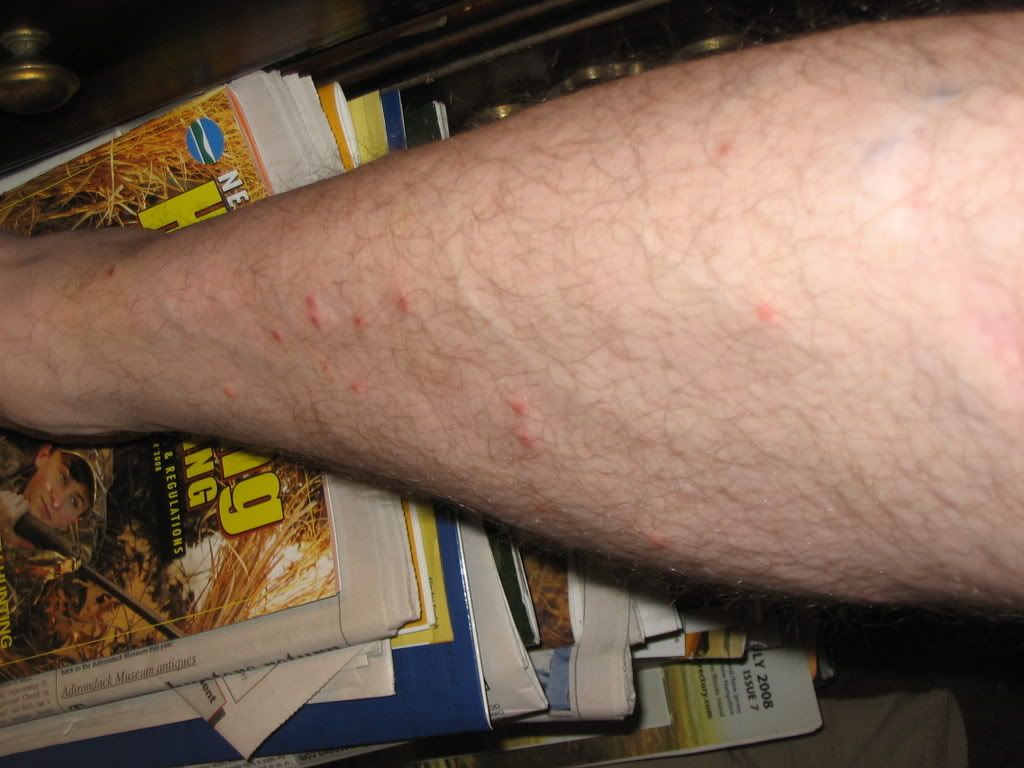
After much research, I've now come to believe that these bites, shown here on my lower leg, and only a small portion of them, are actually from chiggers.
We never had chiggers up here beforea few years ago. I always thought that they were pests of the South, but I guess their range has expanded.
I've probably got 150 itchy bites, and judging by past experience, they will probably itch for about two weeks....
Not much fun, but that's life in the big city!
I's love to hear from some of the Southern readers on how they deal with these chiggers...
Sunday, October 12, 2008
Ticks are getting more vicious

Woodcock season opened here on 10/6. A friend told me he had seen a few about, so I figured I'd give it a try. The weather was quite warm... not a good sign.
We have a new tick in these parts called the Lone Star, a truly agressive little demon that can put the fear of God into a gunner, or anyone else tramping the woods. Dog ticks I eat for breakfast. Deer ticks are nasty little creatures, but I can deal with them. These Lone Star ticks; some of the guys around here still call them chiggers, attack en masse, and can make life miserable for weeks. The most insidious feature of these ticks is that I cannot even see them, so, they cannot be picked off. Showering doesn't help, but agressive toweling after might somewhat.. or just move them around. Ticks are exceedingly tough creatures!
I have no WC for my efforts, but I do have about forty oozing bites... Mostly on the legs, some on the belly, and a few on the arms because of the T-shirt huntin' weather.
I've never been one to care for chemical solutions on my tender body, but these ticks are bad enough to make me rethink that non-solution! Especially since Eastern Equine Encephalitis was detected in these ponds that we were hunting around. West Nile is still a big concern also.
I picked some REPEL for my clothes, and dug out some Ben's 100 (100% DEET) for the rest of me. The military now recommends a two pronged attack such as this for insect infested areas that it's soldiers must operate in.
So for those who frequent areas where these pests have not appeared yet, consider yourselves lucky, but they might just be on the way. As a kid in this area, all we had to worry about were dog ticks... How things have changed....
Chemicals take some time to poison a person, so at this stage in my life, I figure I can take the chance..
Friday, September 12, 2008
Triple-E detected
As usually happens this time of year, Triple-E, or Eastern Equine Encephalitis has been detected in mosquitos from the ponds in the area. Samples were taken only yards from the gunclub.
Now, this is nothing new this time of year, but the numbers of mosquitos carrying the disease is markedly higher.
Triple-E is considered the most serious of mosquito borne diseases, and reportedly carries a 60% mortality rate. I don't usually like dousing myself in chemical repellents, but this disease is worthy of respect..
Be careful out there..
Now, this is nothing new this time of year, but the numbers of mosquitos carrying the disease is markedly higher.
Triple-E is considered the most serious of mosquito borne diseases, and reportedly carries a 60% mortality rate. I don't usually like dousing myself in chemical repellents, but this disease is worthy of respect..
Be careful out there..
Subscribe to:
Comments (Atom)


